Energy for Health, Vol. 25, 2025
Cesar Puertolas1, Jacqueline Puertolas1
1 Belrose - Frenchs Forest Podiatry Centre - 9 Blackbutts Rd, Frenchs Forest NSW 2086, Australia
Abstract
Background: Avulsion fractures of the ischial tuberosity are uncommon injuries in pediatric athletes that can significantly impair function. Conservative management is generally preferred when displacement is limited, but return to sport often requires several months.
Case presentation: We describe a 12-year-old male athlete who sustained an acute avulsion fracture of the right ischial tuberosity during an Australian Rules Football match. Initial management included protected weight-bearing and suspension from sports. Upon parental request, adjunctive photobiomodulation therapy (PBMT) was initiated using the MLS® Robotic M8 laser system.
The seven-week protocol involved simultaneous treatment of the avulsion site and proximal hamstring with tailored parameters delivered by a handheld applicator and a robotic scanning head. MRI at week six demonstrated reattachment of the fragment with bridging callus formation and resolution of surrounding edema. Clinically, the patient had discontinued crutches, started jogging, and by week seven had returned to full participation in both soccer and AFL without pain or functional limitations. No adverse effects or physiotherapy were required, and surgery was definitively avoided.
Conclusion: This is, to our knowledge, the first documented case of a pediatric ischial tuberosity avulsion fracture managed with adjunctive PBMT. The therapy was well tolerated and associated with accelerated clinical and radiological recovery, enabling full return to sport in less than two months. These findings suggest that PBMT may be a safe and valuable adjunct to conservative management of apophyseal avulsions in young athletes, warranting further clinical investigation. Further controlled studies are needed to validate these findings and explore their applicability in pediatric sports medicine.
Introduction
Avulsion fractures of the ischial tuberosity are uncommon injuries that predominantly affect skeletally immature athletes. They usually occur during sports requiring sprinting, jumping, or forceful kicking, when a sudden eccentric contraction of the hamstrings avulses the unfused ischial apophysis [1,2]. Although rare in the general pediatric population, these lesions are not negligible in sports medicine: in the largest published series of pelvic apophyseal avulsions, the ischial tuberosity represented the most frequent site, accounting for more than half of the 203 cases collected in adolescent athletes [5].
Diagnosis can be challenging, as symptoms often mimic hamstring strain, and delayed recognition may result in prolonged pain, functional limitation, or even pseudarthrosis [5]. Standard imaging includes radiographs to assess fragment displacement and, when necessary, magnetic resonance imaging (MRI) to evaluate associated soft tissue injury [1].
Management depends primarily on the degree of displacement. Conservative treatment—consisting of rest, protected weight-bearing, and gradual rehabilitation—is recommended for displacements <15–20 mm, with expected return to sport in approximately 8–12 weeks [1,3]. Surgical fixation is generally indicated in cases of greater displacement, persistent pain, or delayed union [1]. Despite appropriate treatment, recovery may be prolonged, particularly when diagnosis is delayed or in athletes with underlying risk factors [3].
Adjunctive strategies aimed at enhancing recovery in conservatively managed cases have been explored. These include ultrasound-guided percutaneous fenestration [5] and, more recently, extracorporeal shockwave therapy in young gymnasts [6]. Photobiomodulation therapy (PBMT) has also emerged as a promising option. Preclinical and clinical evidence indicates that PBMT can reduce inflammation, stimulate osteoblast proliferation, promote angiogenesis, and accelerate bone callus formation [7–9]. Meta-analyses of randomized controlled trials suggest potential benefits in pain reduction and functional recovery after fractures, although the certainty of evidence remains low and standardized protocols are lacking [7].
To date, however, no reports have described the use of PBMT in pediatric ischial tuberosity avulsion fractures. This case report presents the first documented instance of such an application, highlighting the potential role of PBMT as a safe and non-invasive adjunct to conventional management in young athletes.
Case Presentation
A 12-year-old male competitive athlete, active in both soccer and Australian Rules Football (AFL), with no relevant past medical history, sustained an acute injury during an AFL match. While performing a forceful kicking motion, he experienced sudden sharp pain in the right gluteal region accompanied by an audible “pop.” He was immediately unable to bear weight on the affected limb and required assistance off the field.
On clinical examination, marked tenderness was noted over the right ischial tuberosity, and the patient was completely unable to ambulate. Magnetic Resonance Imaging (MRI) performed the following day confirmed a complete avulsion of the right ischial tuberosity, with inferior and lateral displacement of the apophyseal fragment (Figure 1). The coronal STIR sequence demonstrated a well-defined osseous fragment surrounded by high-signal intensity, consistent with acute edema and hemorrhagic infiltration. Retraction of the hamstring tendon origin from the ischial base was also evident, resulting in loss of continuity between the fragment and the pelvis. No additional fractures, acetabular involvement, or hip joint abnormalities were detected, and the left hemipelvis appeared structurally normal. These findings confirmed a high-grade apophyseal avulsion injury, raising concern for possible surgical intervention should conservative management prove insufficient.
Initial orthopedic management included non-weight-bearing with crutches for six weeks, suspension from sporting activities for twelve weeks, analgesics as required, and a scheduled orthopedic review at week six.
In parallel with the orthopedic plan, and upon parental request, adjunctive photobiomodulation therapy (PBMT) was initiated using the Multiwave Locked System (MLS®) Robotic M8 device. The treatment protocol lasted seven weeks, with a total of 26 sessions. During the first week, therapy was delivered on five consecutive days, followed by three sessions per week for the subsequent six weeks. Each treatment included irradiation of both the avulsion site and the proximal hamstring muscle belly. For the avulsion site, a handheld applicator in scanning mode (beam spot ≈3 cm²) was used to deliver localized energy. For the hamstring, a robotic multidiode scanning head (beam spot ≈20 cm²) ensured uniform, hands-free irradiation of the musculotendinous region. Figure 2 illustrates this dual approach, which allows different anatomical regions to be treated simultaneously with distinct parameter settings. The dosimetric parameters applied throughout the treatment period are summarized in Table 1.
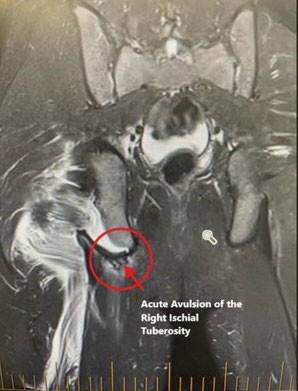
Figure 1
Baseline coronal STIR MRI of the right pelvis showing complete avulsion of the ischial tuberosity with inferior and lateral displacement of the apophyseal fragment, surrounding edema, and retraction of the hamstring origin.
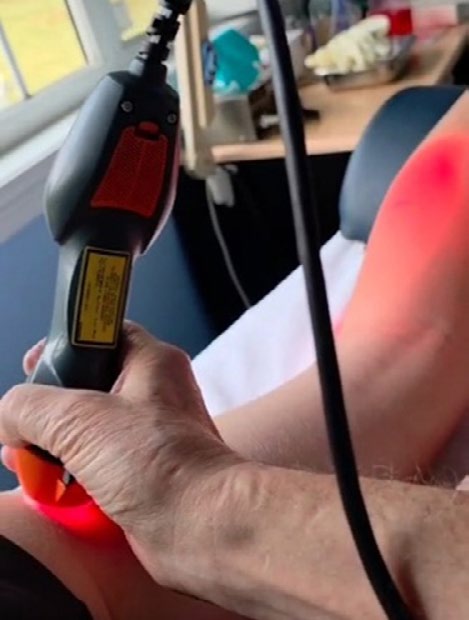
Figure 2
Example of MLS® Robotic M8 laser therapy session. The handheld applicator (spot area ~3 cm²) was applied over the ischial tuberosity, while the robotic scanning head (spot area ~20 cm²) simultaneously treated the proximal hamstring, allowing distinct treatment protocols to be delivered in the same session.
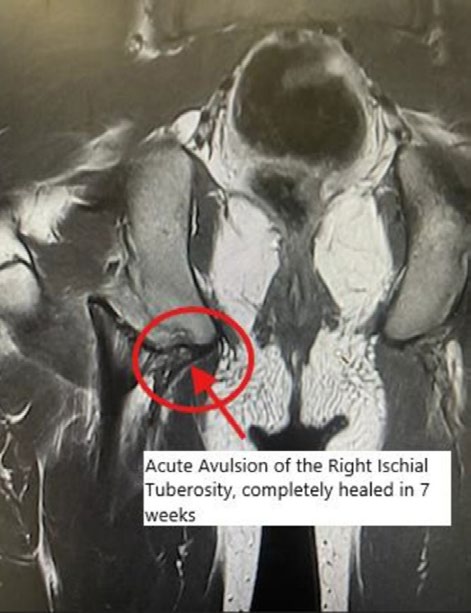
Figure 3
Coronal STIR MRI of the right pelvis at week six showing reattachment of the apophyseal fragment to its anatomical base, bridging callus formation, and marked resolution of surrounding edema.
| Anatomical Zones Treated | Weeks | Area Covered (cm2) | Protocol | Frequency (HZ) | Intensity (%) | Duration (Min:Sec) | Energy (J) | Dose (J/cm2) |
|---|---|---|---|---|---|---|---|---|
|
Ischial Tuberosity |
1-3 |
69 |
Anti-Edema |
1500 |
100 |
12:00 |
477.30 |
6.92 |
|
|
4-7 |
20 |
Bio-stimulation |
1500 |
100 |
06:00 |
238.32 |
11.92 |
|
Hamstring |
1-3 |
131 |
Anti-Edema |
1500 |
100 |
12:00 |
1433.89 |
10.95 |
|
|
4-7 |
150 |
Anti-Edema |
1500 |
100 |
06:00 |
714.96 |
4.76 |
Table 1
Dosimetric parameters applied during PBMT protocol.
Results
After the first week of PBMT, the patient reported mild pain reduction, good tolerance to therapy, and no adverse effects. Clinical improvement progressed steadily over the following weeks.
At the six-week follow-up, the patient had discontinued the use of crutches at home, although he still required them during school activities. The orthopedic specialist authorized the initiation of light jogging. Follow-up MRI at this time revealed clear evidence of anatomical and biological healing at the avulsion site. Compared with the baseline scan, which had shown a displaced fragment with surrounding edema, the week-six image demonstrated reapproximation of the fragment to its anatomical base, bridging callus formation, and resolution of peri-lesional edema (Figure 3). The hamstring origin appeared continuous, without signs of retraction or scarring, and no additional abnormalities were noted in the pelvis, hip joints, or surrounding musculature.
By the seventh week after injury, the patient had resumed full participation in both soccer and Australian Rules Football. He reported no residual pain, weakness, or functional limitation. Physiotherapy was not required, and surgical intervention— initially considered due to the degree of displacement—was definitively ruled out. The accelerated clinical and radiological recovery was further confirmed when the patient participated in his AFL grand final, playing without pain and scoring a goal, as reported by his mother.
Discussion
Ischial tuberosity avulsion fractures are uncommon injuries in adolescent athletes, but they represent a clinically significant challenge due to their potential for delayed diagnosis and prolonged recovery. Current literature indicates that most cases can be managed conservatively with good outcomes, but the expected return-to-sport time is typically around 8–12 weeks, with reports of prolonged recovery up to 6–12 months in cases of delayed recognition or comorbidities such as endocrine disorders [3,5,12]. For instance, Meshram et al. described a gymnast with growth hormone deficiency who required 12 months to resume competitive activity after nonoperative treatment [12].
The present case demonstrates a markedly faster recovery, with return to full sport participation at 7 weeks, substantially shorter than the standard timelines reported in the literature [3,5]. Several factors may have contributed to this accelerated outcome, including strict adherence to the conservative protocol, early diagnosis, and the addition of photobiomodulation therapy (PBMT) as an adjuvant modality.
The biological rationale for PBMT in bone healing is well established. Experimental studies have demonstrated its capacity to stimulate osteoblast proliferation, angiogenesis, and callus mineralization, while modulating the inflammatory response [7,9,10]. Chauhan and Sarin, in one of the earliest randomized controlled trials, reported earlier pain resolution and faster return to ambulation in patients with tibial stress fractures treated with PBMT compared to placebo, although the study was underpowered to achieve statistical significance [7]. More recently, Lawrence et al. highlighted the potential of PBMT to enhance bone repair and emphasized the need for standardized clinical protocols [9].
In the muscular domain, the evidence is more heterogeneous. Animal studies consistently show beneficial effects of PBMT on muscle regeneration and reduction of fibrosis [9]. However, clinical trials have produced mixed results. For example, Medeiros et al., in a randomized controlled trial on hamstring strains, found no significant reduction in return- to-play time when PBMT was added to an exercise-based rehabilitation program, although both groups achieved full recovery [11]. This suggests that while PBMT may exert biological effects at the tissue level, its translation into clinically measurable acceleration of recovery remains dependent on treatment parameters, injury type, and patient characteristics.
The use of the Multiwave Locked System (MLS®) laser may represent a further innovation. By synchronizing continuous 808 nm and pulsed 905 nm emissions, MLS® therapy has been proposed to combine anti-inflammatory and biostimulatory effects, potentially leading to more consistent clinical outcomes. A recent systematic review using text-mining approaches confirmed an increasing number of publications supporting MLS® therapy in musculoskeletal pain and tissue healing, while highlighting the need for protocol standardization [13].
This case has several limitations. Being a single case report, it cannot establish causality, and the favorable outcome may have been influenced by patient compliance and individual biological variability. No direct comparator was available, and the lack of quantitative measures of bone healing, such as serial radiographic scoring or bone turnover markers, limits the ability to draw firm conclusions. Nevertheless, this remains the first documented case of a pediatric ischial tuberosity avulsion fracture successfully treated with PBMT as part of conservative management, suggesting that PBMT may play a valuable role in accelerating recovery and supporting safe return to sport.
Conclusion
This case report describes the successful management of an acute ischial tuberosity avulsion fracture in a pediatric athlete through conservative treatment complemented by adjunctive photobiomodulation therapy (PBMT). The integration of standard orthopedic care with a structured MLS® laser protocol was associated with rapid pain relief, early radiological signs of bone healing, and a full return to competitive sports within seven weeks—considerably earlier than the recovery timeframe typically expected with conservative treatment alone.
PBMT appears to be a safe, non-invasive, and well-tolerated therapeutic option that may enhance biological repair and functional recovery in apophyseal injuries. Although this case supports its potential role in accelerating healing and possibly reducing the need for surgery, larger prospective and controlled studies are warranted to confirm these findings and to define standardized treatment protocols for pediatric populations.
Bibliography
- Ferlic, P. W., Sadoghi, P., Singer, G., Kraus, T., & Eberl, R. (2014). Treatment for ischial tuberosity avulsion fractures in adolescent athletes. Knee Surgery, Sports Traumatology, Arthroscopy, 22(4), 893–897. https://doi.org/10.1007/s00167-013-2444-9
- Di Maria, F., Testa, G., Sammartino, F., et al. (2022). Treatment of avulsion fractures of the pelvis in adolescent athletes: A scoping literature review. Frontiers in Pediatrics, 10, 947463. https://doi.org/10.3389/fped.2022.947463
- Meshram, P., Vadhera, A. S., Sachdev, R., & McFarland, E. G. (2022). Delayed recovery after nonoperative treatment of an avulsion fracture of the ischial tuberosity in an adolescent gymnast: A case report. International Journal of Sports Physical Therapy, 17(5), 941–944. https://doi.org/10.26603/001c.34883
- Harris, J. D., Griesser, M. J., Best, T. M., & Ellis, T. J. (2011). Treatment of proximal hamstring ruptures: A systematic review. International Journal of Sports Medicine, 32(7), 490–495. https://doi.org/10.1055/s-0031-1273716
- Schoensee, S. K., & Nilsson, K. J. (2014). A novel approach to treatment for chronic avulsion fracture of the ischial tuberosity in three adolescent athletes: A case series. International Journal of Sports Physical Therapy, 9(7), 974–990.
- Omodani, T., & Takahashi, K. (2023). Focused extracorporeal shock wave therapy for ischial apophysitis in young high-level gymnasts. Clinical Journal of Sport Medicine, 33(2), 110-115.
- Neto, F. C. J., Martimbianco, A. L. C., De Andrade, R. P., Bussadori, S. K., Mesquita-Ferrari, R. A., & Fernandes, K. P. S. (2020). Effects of photobiomodulation in the treatment of fractures: a systematic review and meta-analysis of randomized clinical trials. Lasers in Medical Science, 35(3), 513-522.
- Lawrence, J., & Sorra, K. (2024). Photobiomodulation as medicine: PBM for acute tissue injury or sport performance recovery. Journal of Functional Morphology and Kinesiology, 9(4), 181. https://doi.org/10.3390/jfmk9040181
- Previti, A., Pugliese, M., Meggiolaro, S., & Passantino, A. (2025). A systematic review via text mining approaches of human and veterinary applications of photobiomodulation: focus on multiwave locked system laser therapy. Lasers in Medical Science, 40(1), 321.
- Chauhan, A., & Sarin, P. (2006). Low level laser therapy in treatment of stress fractures tibia: A prospective randomized
trial. Medical Journal Armed Forces India, 62(1), 27–29. https://doi.org/10.1016/S0377-1237(06)80154-1 - Medeiros, D. M., Aimi, M., Vaz, M. A., & Baroni, B. M. (2020). Effects of photobiomodulation on hamstring strain injury rehabilitation: A randomized controlled trial. Physical Therapy in Sport, 42, 124–130. https://doi.org/10.1016/j.ptsp.2019.12.009