Daniel L. Waldman, DPM, FACFAS is committed to advancing podiatric care with state-of-the-art therapies and a direct care model that eliminates interference from third parties. His approach focuses on health beyond the lower extremities and incorporates techniques that help the body heal itself.
As he celebrates his 30th year in practice at Blue Ridge Foot Centers in Asheville, North Carolina, Dr. Waldman reflects on the success of this practice model and the expanded care opportunities that it has brought to his patients. Without the burden and limitations of insurance, he is able to lower his patient volume and spend more time per patient. The additional freedom and flexibility to understand the patient’s condition allows him to develop personalized care plans that address the underlying cause of their pain, instead of just suppressing the symptoms.
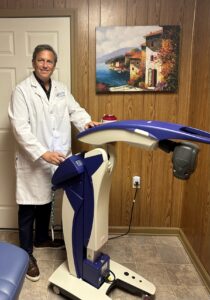 “My goal is to help the body heal itself. I don’t want to cover up the problem. I want to do what I can to get the patient back into a healthy homeostasis where the body is functioning optimally—biomechanically and biochemically,” explains Dr. Waldman.
The goal of this approach is to optimize health and advance wellbeing beyond the physical pain by taking into consideration the kinetic chain principles as well as lifestyle, diet, and nutrition.
“Physicians need to take the extra time to understand we’re not just treating the foot. We treat the full body. Ask yourself: how is their foot pain affecting their full body health and quality of life?” encourages Dr. Waldman. “It’s not just the heel pain that they’re having, or the achilles pain, or muscle strain, but now they can’t play with their grandkids. They can’t take their dog on a walk. There’s emotion and psychological discomfort beyond the physical pain itself. There’s the pain of losing contact with friends and family and not being able to do the activities they want.”
Switching to a direct care model also enabled Dr. Waldman to explore a wide range of innovative treatment technologies to achieve the most advanced and highest quality care available, including Swift microwave therapy, MicroVas ionic impulse therapy, MLS® Laser Therapy, and others not typically covered by insurance.
“Out of all the treatments I do using those machines, the MLS Laser is probably the busiest,” shared Dr. Waldman. “We perform around eight to twelve treatments per day.” The MLS Therapy Laser delivers a concentrated beam of controlled light energy into the tissue to stimulate biological processes on a cellular level resulting in faster healing, reduced inflammation, and pain relief.
“I find it fascinating that these two wavelengths of light can work synergistically and, on a cellular level, increase metabolic activity that energizes and promotes healing,” Dr. Waldman explained. “We’ve got these bodies that are made of atoms and they react to physical stimulation, like a leaf doing photosynthesis. It’s really remarkable.”
One of his favorite and most common treatments is for posterior heel pain. Many of these patients are seeking alternative solutions because they want to avoid or delay the potential risks and complications of surgery and don’t want to be restricted during the recovery time. “After three MLS Laser treatments, the majority of these patients tell me that they’re upwards of 50% to 80% improved with their pain level.”
While many patients with insertional achilles tendinopathy may still require surgery to remove the bone spur, Blue Ridge Foot Centers offers MLS Laser Therapy to manage their inflammation and pain in the interim. “If I can buy them a few months of pain relief, that’s a lot better than having to rush into surgery right away.”
In addition to pain management, Dr. Waldman uses MLS Laser Therapy pre-surgery to stimulate the metabolic processes needed to heal, preparing them for a smoother recovery. Patients experiencing pain in their feet may become sedentary, sometimes up to several months before seeing a physician. This decrease in activity can result in poor circulation and atrophy. Dr. Waldman explains, “We use MLS Laser Therapy to activate the tissue before they need to heal, bringing the tissues to an optimal level before surgery.”
MLS Laser Therapy can also be used post-surgically to control pain and edema, especially after procedures that involve hardware such as plates and screws.
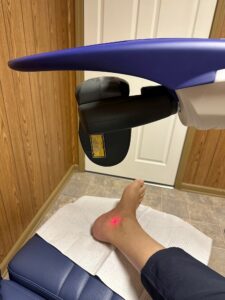 Some of Dr. Waldman’s most common non-surgical patients include middle school, high school and college athletes who are looking for a faster way to heal from sprains, strains, stress fractures and other common athletic injuries. “I love treating athletes because they get back in the game fairly quickly,” shared Dr. Waldman. “I look at the MLS Laser as a way of jumpstarting the metabolic process to heal. We’re really activating and energizing the tissues to heal.”
As an early adopter, Dr. Waldman has over 10 years of experience with the MLS Therapy Laser technology. In the beginning, his patients saw great results with an early stationary model, but treatments required a dedicated technician. Understanding the value of his and his staff’s time, Dr. Waldman later upgraded to a newer model with a robotic and unattended delivery system to improve productivity While laws and regulations vary by state, North Carolina allows staff at Blue Ridge Foot Centers to administer laser treatments, even if Dr. Waldman is out of the office with the condition that he is available by phone.
After treatment protocols are programmed into the machine by staff, the robotic emission system autonomously performs the 15-minute treatment by scanning the designated tissue area. This allows staff to dedicate their time to other practice services while patients are receiving laser therapy. “When you think about the unattended aspect, you’re compounding your time and therefore compounding your revenue,” Dr. Waldman advises.
After shifting to a non-insurance model, Blue Ridge Foot Centers experienced minimal pushback from patients. “Patients are willing to pay out of pocket when they understand the services and outcomes are superior,” shares Dr. Waldman. “It’s about presentation and how you educate your patients.”
Dr. Waldman views patient education as a fundamental aspect of his career and ensures that all patients are given the necessary information to make the best possible decisions for their health. After sharing literature and resources to the patient, he provides ample time to review and ask questions before leaving the clinic so they can feel confident in their understanding of their treatment options.
Many of Dr. Waldman’s patients have gone through traditional methods such as medications and steroid injections that simply suppress the symptoms. After exhausting these options with unsatisfactory results, these patients are actively seeking physicians who are able to treat the underlying cause with advanced solutions. Some driving up to two hours to receive treatments at his clinic. “They’re calling my office because word got out that I do this treatment. I get referrals from primary care physicians. I even get referrals from some of my colleague podiatrists who don’t have the laser.”
After seeing firsthand how the direct care model coupled with advanced treatment technologies has elevated patient care at his practice, Dr. Waldman has made it his personal and professional mission to advance the field of podiatry by educating his colleagues on alternatives solutions and the advantages of non-insurance practice models.