Podiatrists face growing pressure to provide effective treatment options and manage the operational challenges of running a busy practice—all while battling decreasing insurance returns. As a result, podiatrists are struggling to balance patient care with profitability.
Joel Foster, DPM, recognized these challenges and sought a solution that would not only enhance patient outcomes but also streamline practice operations. By incorporating MLS Laser Therapy into his clinic, he discovered a way to offer advanced, non-invasive care while improving workflow and generating additional revenue.
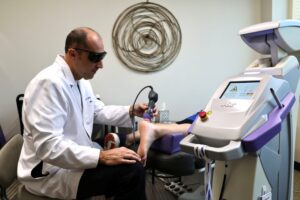
At the core of Dr. Foster’s philosophy is non-invasive treatments. “We’re always looking at non-surgical solutions and ways to avoid injections or pills,” Dr. Foster explains. “With MLS Laser Therapy, we can avoid surgery and injections while maintaining high efficacy and patient satisfaction. We tell patients, yes, this will cost a little, but we have an over 80% success rate.”
This approach resonates with patients seeking alternatives to surgery, especially for chronic conditions like plantar fasciitis or tendonitis. Offering a non-invasive solution with high efficacy has improved patient outcomes and enhanced the patient experience, building trust and loyalty.
One of Dr. Foster’s most transformative decisions was transitioning his practice to a cash-based model, freeing it from the constraints of insurance. “We are one of very few podiatrists in the country that has completely transitioned out of insurance altogether,” Dr. Foster says. “Cash-based treatment lets us go back to what we started in: treating patients.”
For Dr. Foster, this shift allows him to focus entirely on patient care without the administrative burdens of insurance-based care. Embracing a cash-based model has allowed him to provide more personalized attention, ensuring higher-quality care. Patients appreciate this personalized approach and the best-in-class technology available to them, including MLS Laser Therapy.
Dr. Foster’s practice is built on a highly efficient operational model, with MLS Laser Therapy playing a pivotal role in enhancing workflow. “I have a dedicated MLS Laser Therapy room where I have a staff member, and laser is all they do. That room generates revenue without my direct involvement,” Dr. Foster says. “Traditionally, as a healthcare provider, if you’re not performing a service or treatment, you’re not making any money. But the laser room can run even when you’re out of town or performing surgery.”
This setup has not only increased the practice’s capacity but has also created a sustainable revenue stream independent of Dr. Foster’s direct involvement. Having a dedicated staff member in charge of the laser therapy room adds another layer of continuity and personalized care, with patients returning to the same person for treatment adjustments and feedback.
In Dr. Foster’s cash-based model, there’s a strong emphasis on delivering high-quality, individualized care. By eliminating insurance constraints, he can focus more on understanding patients’ needs. “When you’re seeing 30 to 40 people a day, how good of care can you really give somebody? You can’t. If your goal is patient care and patient education, you have to stop and say, ‘There is a better way.’”
With this model, Dr. Foster can spend more time discussing treatment options and outcomes with his patients, tailoring care to their specific needs. “I’m able to see a patient that’s been passed to three or four different providers, sit down, and talk about what they’re experiencing. Then we can come up with a solution to see them get better,” he says.
Dr. Joel Foster’s journey with MLS Laser Therapy illustrates how advanced technology, combined with a patient-centric approach, can transform a podiatry practice. By embracing a cash-based model, improving workflow with advanced technology, and focusing on non-surgical solutions, Dr. Foster has created a practice that excels in both patient care and financial success.
Embracing technology and practice solutions that focus on high efficacy, streamlined integration, and operational benefits is key to evolving your practice, improving patient outcomes, enhancing your workflow, and driving significant financial returns.