C. Calderone1, L. Prussiani1, S. Meggiolaro2, M. Pugliese*3, A. Passantino3, A. Previti3
1 Veterinary Practitioner, via Pallone Ultima 1,42016, Guastalla (RE), Italy
2 Veterinary Practitioner, via G. B. Piazzetta 12, -35031, Abano Terme (PD), Italy
3 Department of Veterinary Sciences, University of Messina, Via Palatucci 13, 98168, Messina, Italy
* Corresponding Author: Michela Pugliese ([email protected])
Summary
Mastitis is a significant challenge in dairy farming, traditionally managed with antibiotics. However, the widespread use of antibiotics has raised concerns regarding antibiotic resistance and animal welfare. As a result, alternative treatments such as lasertherapy have gained increasing attention.
This pilot study aimed to evaluate the efficacy of near-infrared (NIR) Multiwave Locked System (MLS®) laser therapy in the treatment of Chronic Subclinical Mastitis (CSM) (Trial 1) and Acute Subclinical Mastitis (ASM) (Trial 2) in dairy cows.
Cows were randomly assigned to either the control or treatment groups, with the treatment group receiving MLS®laser thera-py over a two-week period. Milk samples were analyzed for Somatic Cell Count (SCC), Differential Somatic Cell Count (DSCC), lactose, and fatty acid profiles at multiple time points (day 0, 7, 14 and 21 after the treatment).
In CSM cases laser therapy showed a trend towards reduced SCC compared to controls with significant differences in De Novofatty acids suggesting improvements in udder health. However, lactose reduction in the control group indicated ongoing inflammation, potentially exacerbated by environmental stressors. In ASM cases significant decreases in DSCC were observed post-treatmentsuggesting a potential benefit of laser therapy in managing acute inflammatory responses.
While the study’s small sample size and short follow-up limit the generalizability of the findings, the results suggest that MLS®laser therapy may be an effective alternative treatment for managing both chronic and acute subclinical mastitis in dairy cows.Further studies with larger sample sizes and longer follow-up periods are necessary to confirm these results and assess the long-term efficacy of laser therapy in mastitis management.
Keywords
Subclinical Mastitis; dairy cattle; Laser Therapy; Inflammation reduction
Abbreviations
Introduction
In dairy cattle, mastitis, an inflammation of the mammary gland, is a prevalent and economically significant issue in milk-producing animals (1). Etiologically, mastitis can be classified aseither infectious or non-infectious.
Infectious mastitis is caused by bacterial, fungal, or other microbial infections. Common bacterial agents include Staphylococcus aureus, Escherichia coli, and Mycobacterium tuberculosis, among others (2, 3). Fungal agents, such as Candida spp., can also be responsible in some cases (4).
Non-infectious mastitis includes conditions not directly caused by pathogens, such as traumatic or toxic. Examples include idiopathic granulomatous mastitis, where the cause is unknown, and other forms related to physical or chemical irritation (5).
Clinical mastitis results in visible inflammation of the udder and abnormal milk, which may be lumpy, watery, bloody, or yellowish. It is usually accompanied by increased SCC in milk and signs of udder inflammation, such as swelling, redness, and pain. Pathogens are more commonly present in the milk of cows with clinical mastitis (6). Bacterial culture and PCR are used to identify pathogens causing mastitis with PCR offering faster results and higher sensitivity compared to traditional culture methods (7).
Acute clinical mastitis is often characterized by severe symptoms that affect both the milk and the cow’s overall health, including fever and depression. It is frequently caused by gram-positive and gram-negative bacteria, with Escherichia coli being a common pathogen (8,9). It can lead to significant pathological changes in the mammary gland and abnormalities in milk (9).
Chronic clinical mastitis, typically persistent, can be caused by bacteria such as Staphylococcus aureus and coagulase-negative staphylococci. It often leads to prolonged inflammation and a decrease in both milk yield and quality over time (10).
Subclinical mastitis often presents no obvious symptoms and can only be detected through specific tests, such as measuring somatic cell count (SCC) or using the California Mastitis Test(11). This form of mastitis may occur with or without the presence of intramammary pathogens. Subclinical mastitis cases present a higher incidence occurring 15 to 40 times more frequently than clinical mastitis and affecting approximately 20-30% of cows in a herd annually (11), often with a longer duration (12).
Chronic subclinical mastitis is associated with elevated SCC and can significantly impact milk composition and yield (13).
Various strategies for managing both clinical and subclinical mastitis have been proposed, but none have effectively eliminated the causative agents when used alone (14). A variety of therapeutic regimens, including antibiotics, immunotherapy, and alternative therapies like probiotics and nanoparticle technology, have been evaluated. However, none of these treatments have provided fully effective solutions such standalone treatments, highlighting the need for new therapeutic agents to address antibiotic resistance (14). In cases of clinical mastitis with systemic symptoms, both intramammary preparations and systemic antibiotics are used, selected based on microbiological and antibiotic-sensitivity tests. However, choosing the most suitable antimicrobial treatment remains challenging, particularly in cost-sensitive environments (15).
Mastitis represents a costly disease worldwide, incurring both direct and indirect costs (1,16-17). Effective management and prevention strategies are crucial to mitigate these costs, emphasizing the need for continued research into alternative treatments and improved farming practices (18). This is important for farmers, processors, and consumers. Farmers benefit from payment schemes that reward milk quality and reduce veterinary interventions. Processors prefer milk with low somatic cell content for optimal cheese production. Consumers are increasingly aware of animal health and well-being, with milk quality evaluations reflecting animal welfare (19). Moreover, global public health concerns regarding antibiotic-resistant infectious agents are growing (14). The Common Agricultural Policy (CAP) for 2023-2027 in European Union countries includes goals to promote organic farming, sustainable practices, reduce antibiotic use in animal husbandry, and improve animal welfare. This policy provides economic incentives for farmers who adopt good practices in animal welfare and antibiotic reduction, with specific funds allocated to support these efforts (20).
Laser therapy has been investigated as a non-pharmacological treatment for mastitis in dairy cows with the hypothesis that it could reduce inflammation, promote tissue healing, and alleviate pain, thereby improving animal welfare and reducing antibiotic use. Previous studies on laser therapy for bovine mastitis have shown conflicting results (21, 22-23). Multiwave Locked System (MLS®) laser therapy has shown analgesic, anti-inflammatory, anti-edematous, and reparative effects on both superficial and deep tissues through cellular and molecular mechanisms (24-26).
The NIR wavelengths used by MLS® laser therapy have never been tested for the treatment of bovine mastitis, and based on its mechanisms of action, it was hypothesized to be an appropriate treatment. This pilot study was designed to evaluate the effects of MLS® laser therapy on dairy cows with chronic or acute subclinical mastitis.
Materials and Methods
Study Design
All dairy cows involved in this study were raised on private commercial farms and did not undergo any invasive procedures. The milk samples used for analysis were collected during routine milking. The treatments were supervised by designated personnel and carried out in a suitable farm environment. The cows were fed diets formulated according to the specific regional requirements of their respective farms. The diet composition differed between farms, as one belonged to the Parmigiano Reggiano production area and the other to the Grana Padano production area. However, within each farm, all cows received the same ration and feeding regimen ensuring a balanced and nutritionally adequate diet. These regional differences were not expected to influence the study outcomes. To safeguard animal welfare and group balance, no environmental changes were carried out during the entire trial, and the treatments were applied directly on the farm.
A preliminary clinical examination was conducted, which included measuring body temperature and assessing udder health. This procedure was repeated throughout the trial before administering the treatment and collecting individual milk samples. Periodical clinical evaluations were carried out in collaboration with the company veterinarian and dedicated staff.
Ethic Statement
The study was conducted according to Italian and European rules on animal welfare.
Before the trial, the farmers were informed of the aim of the study and had assurances that their identity would be confidential. They signed an informed consent form.
Animals’ Selection and Samples
From April to August 2023, Holstein dairy cows were select-ed from two dairy farms located in the Emilia-Romagna and Lombardy regions, Italy, and enrolled. Cows were included if they were in their second calving or later, between the 100thand260thday of lactation (DIM).
Animals presenting clinical mastitis were excluded from the study, because this condition requires timely and systemic treatment to safeguard the animal’s health. Therefore, no animals with a systemic or local pathological condition (e.g., lameness)were included in this study.
During the trial, all selected animals were free from clinical diseases.
Cows with structural lesions on the teats or udder, showing clinical signs of inflammation or pathology, and those receiving any pharmacological treatment, including antibiotics, steroids, or non-steroidal anti-inflammatory drugs within the 14 days prior to selection, were also excluded.
Milk Sample and Analysis
All animals underwent testing for somatic cells count (SCC) and differential somatic cell count (DSCC) (PMN and lymphocytes, %).
Quarter milk samples were collected aseptically by veterinarian during daily milking. The animals’ udders were thoroughly rinsed with clean water and dried with paper towels. The teats were then disinfected. After discarding the first stream of milk, approximately 40 ml of milk from each quarter was collected in sterilized tubes and kept at 4°C until the hygienic analysis was carried out at the reference laboratory.
SCC and DSCC were measured using the fluoro-opto-electronic method, utilizing Fossomatic 7DC (Foss Electric A/S, Hillerød, Denmark; according to ISO 13366-2/IDF 148-2: 2006).
Additionally, the Lactoscope FT-A (PerkinElmer, Milan, Italy)was used for a qualitative-quantitative analysis of milk, including Lactose (%m/m), De Novo, Mixed, and Preformed fatty acids (%m/m).
The study identified cows with CSM and ASM by using the SCCand DSCC values. Subclinical mastitis is characterized by elevated SCC levels, typically above 200,000 cells/mL, without visible symptoms (11). DSCC, which measures the proportion of polymorphonuclear neutrophils and lymphocytes, can be used alongside SCC to improve the detection of subclinical mastitis. A DSCC value greater than 65%, along with an SCC above200,000 cells/mL indicates subclinical mastitis (27,28).
Acute mastitis is typically associated with sudden onset and visible symptoms, whereas chronic mastitis is persistent and often subclinical. Chronic subclinical mastitis is identified by consistently high SCC levels over multiple tests, usually above200,000 cells/mL in at least two out of three tests (10).
The combination of SCC and DSCC can help differentiate between chronic and acute forms. Chronic mastitis is often associated with a DSCC of less than 65%, while acute cases mayshow higher DSCC values due to active infection (27).
In addition to the initial screening, clinical examinations and milk analyses were performed on samples collected at different time points: at the pre-treatment baseline visit on day zero(T0), days 7 (T1), 14 (T2), and 21 (T3) after the start of treatment.
Trial Investigation
All animals were initially screened through clinical examination and milk analysis and enrolled if they met the inclusion and exclusion criteria. The cows diagnosed with subclinical mastitis were classified into two groups based on whether they were affected by chronic subclinical mastitis (CSM) or acute subclinical mastitis(ASM) and were included in two separate trials. Both the cows with CSM (Trial 1) and ASM (Trial 2) received treatment with MLS® laser therapy. Depending on the type of mastitis (CSM or ASM), the cows were exposed to different MLS® therapy sessions every 48 hours and examined on days 0, 7, 14 and 21 after treatment.
During each trial, the enrolled animals were divided into a treatment group (receiving laser therapy) and a control group (receiving no interventions). No additional treatments were ad-ministered to the control cows, although they were closely monitored. Treatment was applied immediately after milking. During each session, all four udder cisterns and teats were irradiated using two different laser settings, depending on the target area (teats or udder), as indicated in Table 1.
The M-VET device (ASA S.r.l., Arcugnano, Vicenza) of the MLS® family, a class IV laser which emits near-infrared (NIR) beams with wavelengths of 808 nm to 905 nm, was used for laser therapy. The device emits spatially overlapping and synchronized beams with continuous (or frequency) and pulsed emission modes, delivering an average power of 3.6 W and a peak pow-er of 270 W. The treatment was performed using a 5 cm diameter optical lens to generate a spot area of 19.6 cm2. The veterinarian applied the treatment by positioning the handpiece perpendicular to the udder surface. For both operational efficiency and safety, the laser handpiece was mounted on a telescopic arm of approximately 100-150 cm, allowing the veterinarian to maintain a safe distance from the animal during the treatment. The handpiece was consistently kept perpendicular to the target tissue, positioned just a few centimeters away.Trial 1 – Chronic Subclinical Mastitis (CSM)
A total of 20 animals with CSM were identified and divided into two homogeneous groups of 10 animals each, based on birth order and days of lactation: a control group and a treatment group. A cycle of 5 sessions of MLS® laser therapy began for the cows in the treatment group.
Trial 2 – Acute Subclinical Mastitis (ASM)
A total of 10 animals with ASM were enrolled. They were also divided into two homogeneous groups: treatment and control. Cows in the treatment group received a regimen of 8 sessions of MLS® laser therapy.
Statistical Analysis
The results obtained were expressed as Mean, Median and Standard Deviation (± SD).
In this pilot study, no formal hypothesis testing or power analysis was conducted to determine the sample size. Instead, data were analyzed using both descriptive and inferential statistical methods to evaluate changes over time within and between treatment groups for cows affected by CSM and ASM.
Prior to statistical analysis, the Shapiro-Wilk test was used to assess the normality of data distribution. If the data met the assumption of normality, parametric tests were applied; otherwise, non-parametric alternatives were used. Similarly, Levene’s test was performed to verify homogeneity of variances across groups.
To assess intragroup variations over time, Repeated Measures ANOVA was applied when normality assumption was satisfied. If the data were not normally distributed, a non-parametric approach, such as the Mann-Whitney test for repeated samples, was used. Differences between treatment groups at specific timepoints were analyzed using One-Way ANOVA for normally distributed data, while the Friedman test was applied when normality was not met.
When statistically significant differences were found, post hoc tests were conducted to determine specific group differences. Depending on the statistical te
st used, Nemenyi or Conover post hoc analyses were applied to control for multiple comparisons and ensure robust statistical interpretation. The significance level was set at p < 0.05 for all analyses.
Since SCC data is often skewed, a logarithmic transformation was performed before statistical analysis to facilitate parametric testing where applicable. Specifically, SCC values were transformed using the Linear Score (LS) equation, as described by Guastella et al. (2013):
This transformation allowed for a more standardized evaluation of SCC variations across different time points and treatment conditions.
All statistical analyses were conducted using Python-based tools.
| Application Modality | Frequency (Hz) | Intensity (%) | Energy (J) | Dose (J/cm2) | Total Duration (min:sec) | |
|---|---|---|---|---|---|---|
|
Teats |
Per points, one for teat (n=4) |
36 |
100 |
401.84 |
5.02 |
04:00 |
|
Udder |
Per points, one per quarter (n=4) |
CPWa |
100 |
323.95 |
4.05 |
01:28 |
Table 1
Settings used during MLS® laser therapy sessions, depending on the target area to be treated: teats or udder.
a CPW = Continuous pulsed mode: continuous mode for the 808nm component and pulsed mode at 2000Hz for the 905nm component.
Results
Trial 1 – Subclinical Chronic Mastitis
At T0, no significant differences were observed between the two groups for all variables examined except for Preformed fatty acids, which were higher in the treatment group (p=0.012). This difference was also significant at T1 (p=0.049) and T2(p=0.001).
Intergroup analyses showed no significant differences in Lin-ear Score of SCC (LS_SCC), DSCC, Lactose and Mixed fatty acid between the control and treatment group at all evaluation times. However, at the end of the treatment cycle (T2), De Novo fatty acid showed a significant difference between the treatment and control groups, with higher values in the treatment group (Mean ± SD (Median) – treatment: 0.69 ± 0.17 (0.68); control: 0.49 ± 0.12 (0.52). The p-value was 0.020.
Intragroup analysis found no significant differences for all variables in the treatment group, while the control group exhibited significant variations over time for Lactose (p=0.021), Mixed (p=0.047) and Preformed fatty acids (p=0.005).
Post hoc analyses revealed a significant decrease in Lactose levels between T1-T3, suggesting a progressive mammary inflammatory state. For Mixed Fatty Acids, a significant increase was observed between T0 and T3, and for Preformed fatty acids, a significant increase was noted between T0 and T3 as well as between T2 and T3. For the latter two types of fatty acids, the upward trend could be interpreted as a potential false result, as these parameters may reflect milk production level. Specifically, as milk production decreases, the percentage of these fatty acids tends to increase due to a higher concentration. This observation could also be supported by the decrease in Lactose, which likely indicates reduced osmotic power and a decline in milk production within the control group.
The results of the analyses performed are shown in Table 2 and represented in Figure 1.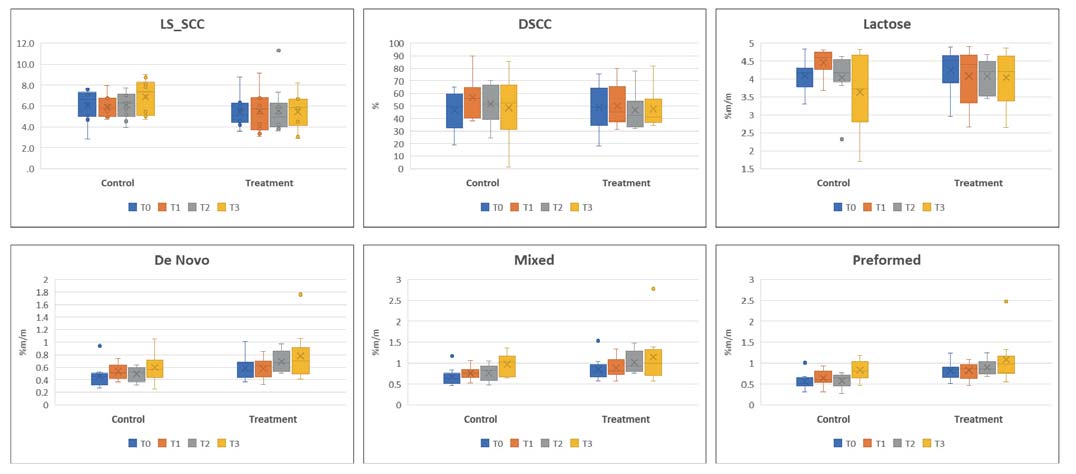
Figure 1
Trial 1: Box plots Chronic subclinical mastitis treatment results for Control and Treatment Groups.
Trial 2 – Acute Subclinical Mastitis
At T0, both groups were homogeneous, and no significant differences were found for all variables.
Analyses conducted between the two groups revealed no significant differences in any variables, except for the LS_SCC and DSCC parameters, which were significantly lower in the treatment group compared to the control group at the T3 follow-up visit (Mean ± SD (Median) – LS_SCC – treatment: 1.76± 1.09 (1.71); control: 3.07 ± 0.54 (2.94); p-value = 0.043); DSCC – treatment: 36.5 ± 15.9 (30.0) %; control: 68.8 ± 13.3 (76.0) %. The p-value was 0.019.
Intragroup analyses for the control group revealed no significant differences over time. In the treatment group, no significant differences were found, except for DSCC, where post hoc analyses between T0 and T3 revealed a significant variation (p= 0.020). Nonetheless, a general decline in both LS_SCC and DSCC parameters over time was observed, with a more pronounced decrease in the treatment group compared to the control group. The results of the conducted analyses are reported in Table 3 and represented in Fig.2
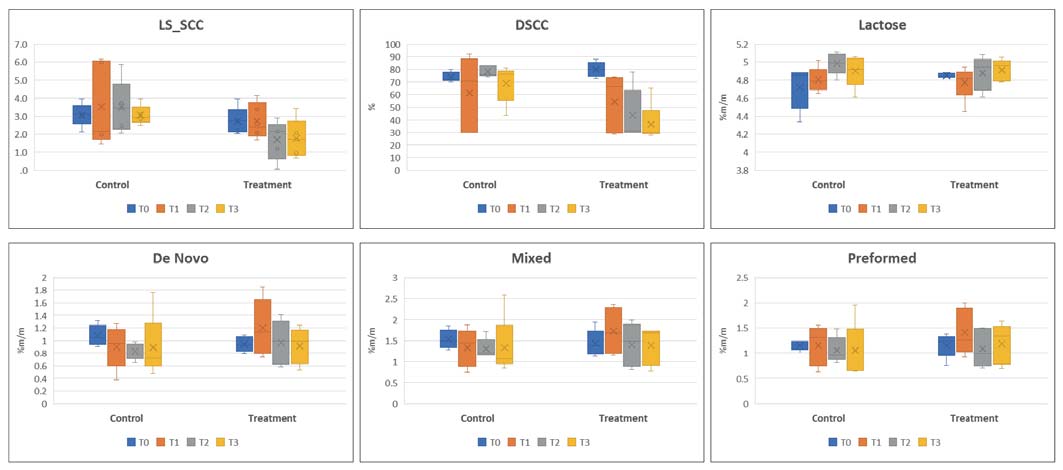
Figure 2
Trial 2: Box plots of the Acute subclinical mastitis treatment, results for Control and Treatment Groups.
|
Control Group (n = 10) mean ± SD (median) |
Treatment Group (n = 10) mean ± SD (median) |
p-value (*) | ||
|---|---|---|---|---|
|
LS_SCC |
T0 |
6.05 ± 1.57 (6.60) |
5.44 ± 1.50 (5.09) |
0.386 |
|
|
T1 |
5.90 ± 1.05 (5.79) |
5.50 ± 1.90 (5.71) |
0.560 |
|
|
T2 |
6.09 ± 1.25 (6.29) |
5.55 ± 2.31 (4.91) |
0.185 |
|
|
T3 |
6.89 ± 1.67 (7.34) |
5.44 ± 1.68 (5.87) |
0.069 |
|
|
p-value (‡) |
0.407 |
0.839 |
|
|
DSCC (%) |
T0 |
46.6 ± 15.6 (49.4) |
48.9 ± 18.5 (49.3) |
0.733 |
|
|
T1 |
56.8 ± 16.3 (56.0) |
49.9 ± 16.5 (45.3) |
0.384 |
|
|
T2 |
51.6 ± 15.8 (51.8) |
46.7 ± 16.4 (42.2) |
0.520 |
|
|
T3 |
48.4 ± 23.9 (52.3) |
47.6 ± 15.9 (41.0) |
0.850 |
|
|
p-value (‡) |
0.517 |
0.989 |
|
|
De Novo (%m/m) |
T0 |
0.46 ± 0.19 (0.46) |
0.58 ± 0.19 (0.54) |
0.069 |
|
|
T1 |
0.53 ± 0.12 (0.51) |
0.58 ± 0.17 (0.63) |
0.495 |
|
|
T2 |
0.49 ± 0.12 (0.52) |
0.69 ± 0.17 (0.68) |
0.020 |
|
|
T3 |
0.60 ± 0.22 (0.56) |
0.78 ± 0.40 (0.70) |
0.272 |
|
|
p-value (‡) |
0.052 |
0.101 |
|
|
Mixed (%m/m) |
T0 |
0.68 ± 0.20 (0.64) |
0.85 ± 0.28 (0.78) |
0.081 |
|
|
T1 |
0.76 ± 0.15 (0.75) |
0.88 ± 0.24 (0.80) |
0.289 |
|
|
T2 |
0.76 ± 0.20 (0.82) |
1.02 ± 0.26 (0.94) |
0.058 |
|
|
T3 |
0.97 ± 0.25 (1.02) |
1.15 ± 0.64 (0.99) |
0.820 |
|
|
p-value (‡) |
0.047 (**) |
0.216 |
|
|
Preformed (%m/m) |
T0 |
0.56 ± 0.19 (0.52) |
0.82 ± 0.20 (0.84) |
0.012 |
|
|
T1 |
0.64 ± 0.19 (0.61) |
0.82 ± 0.19 (0.87) |
0.049 |
|
|
T2 |
0.58 ± 0.17 (0.64) |
0.89 ± 0.18 (0.86) |
0.001 |
|
|
T3 |
0.83 ± 0.24 (0.80) |
1.08 ± 0.53 (0.98) |
0.256 |
|
|
p-value (‡) |
0.005 (**) |
0.240 |
|
|
Lactose (%m/m) |
T0 |
4.09 ± 0.41 (4.18) |
4.25 ± 0.61 (4.52) |
0.384 |
|
|
T1 |
4.46 ± 0.38 (4.60) |
4.08 ± 0.82 (4.40) |
0.289 |
|
|
T2 |
4.04 ± 0.66 (4.17) |
4.08 ± 0.48 (4.20) |
0.850 |
|
|
T3 |
3.64 ± 1.03 (3.72) |
4.04 ± 0.74 (4.20) |
0.427 |
|
|
p-value (‡) |
0.021(**) |
0.506 |
|
Table 2
Trial 1 – Chronic Subclinical Mastitis – Data collected from milk analysis performed at baseline visit (T0), after one week midway through the treatment cycle (T1), after two weeks at the end of the treatment cycle (T2), at follow-up visit one week after the last treatment (T3).
|
Control Group (n = 10) mean ± SD (median) |
Treatment Group (n = 10) mean ± SD (median) |
p-value (*) | ||
|---|---|---|---|---|
|
LS_SCC |
T0 |
3.09 ± 0.66 (3.12) |
2.75 ± 0.76 (2.75) |
0.476 |
|
|
T1 |
3.53 ± 2.32 (2.14) |
2.74 ± 1.01 (2.42) |
0.502 |
|
|
T2 |
3.52 ± 1.47 (3.46) |
1.69 ± 1.11 (2.14) |
0.057 |
|
|
T3 |
3.07 ± 0.54 (2.94) |
1.76 ± 1.09 (1.71) |
0.043 |
|
|
p-value (‡) |
0.92 |
0.202 |
|
|
DSCC (%) |
T0 |
73.7 ± 3.9 (72.0) |
79.8 ± 5.9 (79.6) |
0.095 |
|
|
T1 |
61.4 ± 29.6 (70.5) |
54.4 ± 23.2 (66.3) |
0.525 |
|
|
T2 |
78.2 ± 4.1 (75.8) |
43.6 ± 20.7 (31.2) |
0.059 |
|
|
T3 |
68.8 ± 14.8 (76.0) |
36.5 ± 15.9 (30.0) |
0.019 |
|
|
p-value (‡) |
0.896 |
0.020 (**) |
|
|
De Novo (%m/m) |
T0 |
1.08 ± 0.16 (1.05) |
0.94 ± 0.12 (0.93) |
0.222 |
|
|
T1 |
0.90 ± 0.34 (0.96) |
1.20 ± 0.45 (1.13) |
0.420 |
|
|
T2 |
0.83 ± 0.13 (0.81) |
0.97 ± 0.35 (0.99) |
0.547 |
|
|
T3 |
0.89 ± 0.50 (0.72) |
0.92 ± 0.28 (0.99) |
0.547 |
|
|
p-value (‡) |
0.177 |
0.495 |
|
|
Mixed (%m/m) |
T0 |
1.54 ± 0.22 (1.50) |
1.44 ± 0.32 (1.38) |
0.600 |
|
|
T1 |
1.33 ± 0.45 (1.45) |
1.72 ± 0.55 (1.69) |
0.309 |
|
|
T2 |
1.31 ± 0.24 (1.20) |
1.41 ± 0.51 (1.49) |
0.841 |
|
|
T3 |
1.34 ± 0.70 (1.07) |
1.39 ± 0.45 (1.69) |
0.916 |
|
|
p-value (‡) |
0.781 |
0.668 |
|
|
Preformed (%m/m) |
T0 |
1.16 ± 0.09 (1.17) |
1.16 ± 0.22 (1.24) |
0.600 |
|
|
T1 |
1.15 ± 0.40 (1.31) |
1.42 ± 0.41 (1.26) |
0.547 |
|
|
T2 |
1.06 ± 0.26 (0.95) |
1.09 ± 0.34 (0.99) |
1.000 |
|
|
T3 |
1.05 ± 0.53 (1.01) |
1.19 ± 0.36 (1.34) |
0.529 |
|
|
p-value (‡) |
0.675 |
0.668 |
|
|
Lactose (%m/m) |
T0 |
4.72 ± 0.23 (4.85) |
4.85 ± 0.02 (4.84) |
1.000 |
|
|
T1 |
4.80 ± 0.14 (4.79) |
4.77 ± 0.19 (4.82) |
0.529 |
|
|
T2 |
4.98 ± 0.12 (4.99) |
4.88 ± 0.19 (4.94) |
0.309 |
|
|
T3 |
4.90 ± 0.18 (4.92) |
4.91 ± 0.12 (4.96) |
1.000 |
|
|
p-value (‡) |
0.217 |
0.516 |
|
Table 3
Trial 2: Acute Subclinical Mastitis – Data collected from milk analysis performed at baseline visit (T0), after one week midway through the treatment cycle (T1), after two weeks at the end of the treatment cycle (T2) and at follow-up visit one week after the last treatment (T3).
Discussion
Mastitis is a major challenge for dairy farmers, traditionally managed with antibiotics. However, this approach raises concerns about antibiotic resistance, food safety, and animal welfare. As a result, there has been growing interest in exploring alternative treatments, such as laser therapy. Studies on the use of laser therapy for bovine mastitis have produced varying results. Stoffel et al. (29) found no significant effect of daily 30-minute sessions of low-energy laser irradiation on mastitis. Conversely, Hoedemaker and Hackenfort (22) reported that while antibiotics were slightly more effective, laser therapy alone showed considerable efficacy, particularly when used alongside antibiotics. Beneduci et al.(21) found a significant reduction in milk SCC following laser treatment, suggesting a reduction in inflammation. This pilot study aimed to investigate the effects of MLS® laser therapy on CSM and ASM, using wavelengths not previously tested in this context.
In Trial 1, although significant differences were not observed between the treatment and control groups, the data suggest promising trends that warrant consideration.
The reduction in LS_SCC in the treatment group, even though not statistically significant, suggests a potential positive effect of the laser therapy. At T2, the mean value of LS_SCCin the treatment group increased, while the median value decreased compared to the baseline. This change was primarilydue to one animal with markedly higher SCC values at that time (31×10^6 compared with 3.59×10^6), that had a DSCC value > 65% at baseline (75.4%). This could be attributed to a flare-up in an animal with an underlying chronic condition. Additionally, two cows, one for each group, had SCC values > 200,000n/ml at the screening phase but had values below the minimumthreshold at the baseline visit. However, the final analysis included these animals, as previous studies have shown that SCCtrends in animals with CSM can vary over time.
By the follow-up (T3), 6 out of 10 cows in the treatment group showed a decrease in SCC, with 2 of them having values below 200,000 n/ml. In contrast, only 3 cows in the control group showed a decrease in SCC, and none had SCC values lower than 200,000 n/ml.
As expected, the DSCCs did not change over time in both groups, as CSM is characterized by normal range value for this parameter. A noteworthy finding was the significant decrease in lactose content in the control group, which suggests an ongoing inflammatory process. This reduction could be attributed to the stress experienced by the animals, as the farm area was affected by a meteorological emergency, including storms and floods, during the latter stages of the study. This environmental stress may have exacerbated the inflammatory response in the control group. Another key finding was the significant increase in De Novo fatty acids in the treated group compared to the control at T2. This suggests a positive effect of laser therapy on udder health, as De Novo fatty acids are synthesized exclusively by healthy udder tissue. Considering that CSM is prone to flare-ups due to immune system variations, such as those introduced by stress, it is likely that laser therapy helped maintain the health of udder tissue and control the inflammatory mastitis process in the treated group. Although significant data on De Novo fatty acids at T3 was not identified, the average value in the treated group was higher compared to the control cows. This suggests that the treatment may have had a positive effect, but it was not applied for enough time given the chronicity of the disease.
In Trial 2, a significant outcome emerged: a notable reduction in both LS_SCC and DSCC in the treated group compared to the control group. The decrease in LS_SCC is a common marker of reduced inflammation and infection in the udder. Treatments that lower SCC, such as the use of nonsteroidal anti-inflammatory drugs like meloxicam, have been shown to improve clinical outcomes and reduce culling rates in dairy cows with mastitis (30). The use of laser therapy appears to be pioneering. Furthermore, it was observed that the proportion of animals with DSCC value <65% appeared to differ over time in the two groups: at T2, out of 5 cows in the treatment group had DSCC values below 65%, compared to none in the control group. By the follow-up (T3), 100% of the treated cows showed DSCC <65% unlike the control group.
This finding suggests that MLS® laser therapy may offer a potential benefit in the treatment of acute mastitis, with implications for improving udder health. The significant reduction in both intergroup and intragroup DSCC values further supports the effectiveness of laser therapy in managing ASM. The result obtained is the expected one, because the ACM’s patho-logical process is characterized by a sudden onset of local inflammation, which negatively impacts the health of the udder. However, the pathophysiological mechanisms that subsequently lead to alterations in other analytical parameters have not yet been triggered in contrast with the CSM.
Limitations and Future Directions
Conclusion
In conclusion, the results of this pilot study suggest that MLS® laser therapy may be an effective alternative for managing both chronic and acute subclinical mastitis in dairy cows. In both chronic and acute forms, laser therapy has shown some efficacy signals in improving udder health and reducing inflammation associated with the disease. The potential inclusion of this therapy in treatment protocols to reduce the use of drugs and antibiotics may result in a better quality of life for the animal and contribute to global health needs that require a reduced use of antibiotics.
Additionally, the efficacy of MLS® laser therapy in reducing bacterial infections may be investigated further to determine its impact on antibiotic resistance and global health. However, further studies are needed to fully evaluate its potential and establish its role in mastitis treatment protocols.
Conflict of Interest Statement
SM has received funding for educational consulting and talks from ASA S.r.l. The authors have no other financial or personal relationships with other people or organizations that could inappropriately influence or bias the content of the paper.
Acknowledgements
This study was supported by ASA S.r.l who provided the device under investigation.
Bibliography
- Hogeveen, H., Huijps, K., Lam, T.J.G.M., 2011. Economic aspects of mastitis: new developments. N Z Vet J,59(1):16-23. https://doi.org/10.1080/00480169.2011.547165.
- Singla, D.V., Garg, D.D., Dua, D.A., Bal, D.A., Singh, D.T., Prabhakar, D.N., Dahiya, D.D., 2025. Imaging enigma in mastitis: A comprehensive study of multifaceted causes, clinical and radiological presentations. Curr Probl Diagn Radiol, 54(2):214-227. https://doi.org/10.1067/j.cpradiol.2024.08.006.
- Huma, Z.I., Sharma, N., Kour, S., Lee, S.J., 2022. Phenotypic and molecular characterization of bovine mastitis milk origin bacteria and linkage of intramammary infection with milk quality. Front Vet Sci, 9: 885134. https://doi.org/10.3389/fvets.2022.885134.
- Pinto, T.N., Kohn, A., Da Costa, G.L., Oliveira, L.M.A., Pinto, T.C.A., Oliveira, M.M.E., 2022. Candida guilliermondii as an agent of postpartum subacute mastitis in Rio de Janeiro, Brazil: Case report. Front Microbiol, 13:964685. https://doi.org/10.3389/fmicb.2022.964685.
- Emiroglu, M., Akcan, A., Velidedeoglu, M., Girgin, S., Aytac, O., Canturk, N.Z., Yılmaz, K.B., Koksal, H., Cabio lu, N., Cetin, K., Gulluoglu, B., 2024. Diagnosis, approach, and clinical classification of idiopathic granulomatous mastitis: Consensus Report. Breast care, 19(5): 243-251. https://doi.org/10.1159/000541482.
- Xi, X., Kwok, L.Y., Wang, Y., Ma, C., Mi, Z., Zhang, H., 2017. Ultra-performance liquid chromatography-quadrupole-time of flight mass spectrometry MSE-based untargeted milk metabolomics in dairy cows with subclinical or clinical mastitis. J Dairy Sci, 100(6): 4884-4896. https://doi.org/10.3168/jds.2016-11939.
- Adkins, P.R.F., Middleton, J.R., 2018. Methods for diagnosing mastitis. Vet. Clin. N. Am. – Food Anim. Pract., 34(3): 479-491. https://doi.org/10.1016/j.cvfa.2018.07.003
- Goulart, D.B., Mellata, M., 2022. Escherichia coli Mastitis in Dairy Cattle: Etiology, Diagnosis, and Treatment Challenges. Front Microbiol, 13: 928346. https://doi.org/10.3389/fmicb.2022.928346.
- Babji, B.R., Reddy, G.A.K., Ambica, G., Kumar, S.R., 2020. A Case Study of Clinical Mastitis in a Cow. Int J Curr Microbiol Appl Sci, 9(5):1759-1764. https://doi.org/10.20546/ijcmas.2020.905.198.
- Gonçalves, J.L., Kamphuis, C., Vernooij, H., Araújo Jr, J.P., Grenfell, R.C., Juliano, L., Anderson, K.L., Hogeveen, H., Dos Santos, M.V., 2020. Pathogen effects on milk yield and composition in chronic subclinical mastitis in dairy cows. Vet J, 262: 105473. https://doi.org/10.1016/j.tvjl.2020.105473
- Pakrashi, A., Ryan, C., Guéret, C., Berry, D.P., Corcoran, M., Keane, M.T., Mac Namee, B., 2023. Early detection of subclinical mastitis in lactating dairy cows using cow-level features. J Dairy Sci, 106(7): 4978-4990. https://doi.org/10.3168/jds.2022-22803.
- Cobirka, M., Tancin, V., and Slama, P. 2020. Review Epidemiology and Classification of Mastitis. Animals, 10(12): 2212. https://doi.org/10.3390/ani10122212
- Krishnamoorthy, P., Goudar, A.L., Suresh, K.P., Roy, P., 2021. Global and countrywide prevalence of subclinical and clinical mastitis in dairy cattle and buffaloes by systematic review and meta-analysis. Res Vet Sci, 136: 561-586. https://doi.org/10.1016/j.rvsc.2021.04.021
- Sharun, K., Dhama, K., Tiwari, R., Gugjoo, M.B., Iqbal Yatoo, M.I., Patel, S.K., Pathak M., Kumaragurubaran K., Khurana S.K., Singh R., Puvvala B., Amarpal, Singh R., Singh K.P., Chaicumpa, W., 2021. Advances in therapeutic and managemental approaches of bovine mastitis: a comprehensive review. Vet Q, 41(1): 107-136. https://doi.org/10.1080/01652176.2021.1882713.
- Cockcroft, P., 2015 Diagnosis and clinical reasoning in cattle practice in Bovine Medicine. Pages 124-132. 3rd ed. West Sussex, Chichester, UK: Wiley-Blackwell, John Wiley and Sons Ltd. https://scholar.google.com/scholar_lookup?title=Bovine+Medicine&author=P+Cockcroft&publication_year=2015&.
- Ferchiou, A., Ndiaye, Y., Mandour, M.A., Herman, N., Lhermie, G., Raboisson, D., 2023. The Marginal Abatement Cost of Antimicrobials for Dairy Cow Mastitis: A Bioeconomic Optimization Perspective. Vet Sci, 10(2): 92. https://doi.org/10.3390/vetsci10020092
- Richardet, M., Solari, H.G., Cabrera, V.E., Vissio, C., Agüero, D., Bartolomé, J.A., Bó, G.A., Bogni, C.I., Larriestra, A.J., 2023. The Economic Evaluation of Mastitis Control Strategies in Holstein-Friesian Dairy Herds Animals, 13(10): 1701. https://doi.org/10.3390/ani13101701
- Van Soest, F.J.S., Santman-Berends, I.M.G.A., Lam, T.J.G:M., Hogeveen, H., 2016. Failure and preventive costs of mastitis on Dutch dairy farms. J Dairy Sci, 99(10): 8365-8374. https://doi.org/10.3168/jds.2015-10561
- Bobbo, T., Meoni, G., Niero, G., Tenori, L., Luchinat, C., Cassandro, M., Penasa, M., 2022. Nuclear magnetic resonance spectroscopy to investigate the association between milk metabolites and udder quarter health status in dairy cows. J Dairy Sci, 105(1): 535-548. https://doi.org/10.3168/jds.2021-20906
- Ministero delle politiche agricole alimentari e forestali con il supporto della Rete Rurale Nazionale, 2022. Piano Strategico della PAC 2023-2027 – Documento di sintesi, from https://www.reterurale.it/flex/cm/pages/ServeAttachment.php/L/IT/D/9%252Fe%252F3%252FD.86188f6d24296e1e030f/P/BLOB%3AID%3D24037/E/pdf
- Beneduci A., Chdichimo G., Nappi Mc., Rossi R., Turco R., Lucifora G., Garrafa F., 2007. Evaluation of the effects induced by near infrared low intensity laser radiation on bovine affected by subacute mastitis: a simple quarter foremilk sampling study. J Anim Vet Adv, 6: 761 767. https://iris.unical.it/handle/20.500.11770/152319
- Hoedemaker, M., Hackenfort, E.M., 2003. Use of a low power laser in the treatment of bovine mastitis. Tierarztl Umsch, 58:457 466. https://www.cabidigitallibrary.org/doi/full/10.5555/20033152921
- Malinowski, E., Krumrych, W., Markiewicz, H., 2019. The effect of low intensity laser irradiation of inflamed udders on the efficacy of antibiotic treatment of clinical mastitis in dairy cows. Vet Ital, 55(3): 253-260. http://dx.doi.org/10.12834/VetIt.818.3989.2
- Monici, M., Cialdai, F., Ranaldi, F., Paoli, P., Boscaro, F., Moneti, G., Caselli, A., 2013. Effect of IR laser on myoblasts: a proteomic study. Mol BioSyst, 9(6): 1147-1161. https://doi.org/10.1039/c2mb25398d
- Micheli, L., Cialdai, F., Pacini, A., Branca, J.J.V., Morbidelli, L., Ciccone, V., Lucarini, E., Ghelardini, C., Monici, M., Di Cesare Mannelli, L., 2019. Effect of NIR laser therapy by MLS-MiS source against neuropathic pain in rats: in vivo and ex vivo analysis. Sci Rep 9(1): 9297. https://doi.org/10.1038/s41598-019-45469-5
- Squarzoni, P., Bani, D., Cialdai, F., Monici, M., 2017. NIR laser therapy in the management of feline stomatitis. SM Dermatolog J, 3(3): 1021. 10.36876/smdj.1021
- Schwarz, D., Kleinhans, S., Reimann, G., Stückler, P., Reith, F., Ilves, K., Pedastsaar, K., Yan, L., Zhang, Z., Lorenzana, R., Barreal, M.L., Fouz, R., 2021. Associations between different udder health groups defined based on a combination of total and differential somatic cell count and the future udder health status of dairy cows. Prev Vet Med, 192: 105374. https://doi.org/10.1016/j.prevetmed.2021.105374.
- Zecconi, A., Vairani, D., Cipolla, M., Rizzi, N., Zanini, L., 2018. Assessment of subclinical mastitis diagnostic accuracy by differential cell count in individual cow milk. Ital J Anim Sci., 18(1): 460-465. https://doi.org/10.1080/1828051X.2018.1533391
- Stoffel, M., Schällibaum, M., Schilt, W., Gerber, H., 1989. Low-energy He-Ne-laser irradiation of the bovine mammary gland. Zentralbl Veterinarmed A, 36(8): 596-602. https://doi.org/10.1111/j.1439-0442.1989.tb00770.x
- McDougall, S., Bryan, M.A., Tiddy, R.M., 2009. Effect of treatment with the nonsteroidal anti-inflammatory meloxicam on milk production, somatic cell count, probability of re-treatment, and culling of dairy cows with mild clinical mastitis. J Dairy S, 92(9): 4421-31. https://doi.org/10.3168/jds.2009-2284
- Krebs, I., Zhang, Y., Wente, N., Leimbach, S., and Krömker, V. 2023. Severity of Clinical Mastitis and Bacterial Shedding. Pathogens, 12(9): 1098. https://doi.org/10.3390/pathogens12091098